
Shuttle buses for IDD & disability services
Day programs, residential providers and waiver agencies run more accessible vehicle-miles than almost anyone, with drivers who rotate and riders who need time. We spec for that.
Two vehicles cover most programs
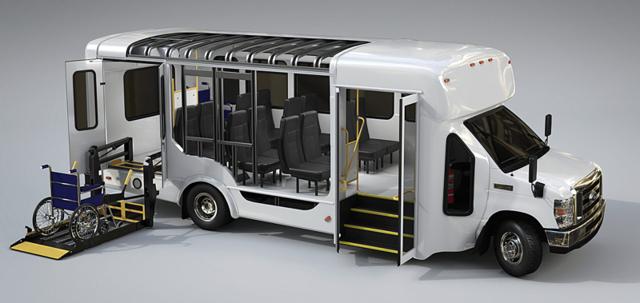
The day-program bus
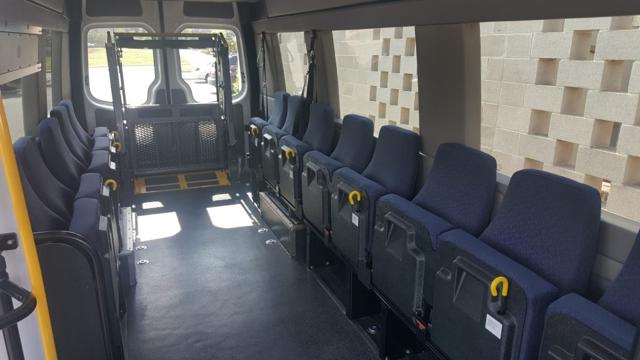
A Ford E-450 cutaway, 25 feet, with two to four wheelchair stations under flip-up seats, a curbside or rear platform lift, and 10–13 ambulatory seats — built at 15 total or fewer so direct-support staff without CDLs can drive it. New, this is the $125,000–$145,000 row of our price table as of September 2026. When a program has CDL drivers, a 20–24 passenger version with four stations moves a whole site in one trip.
The group-home van
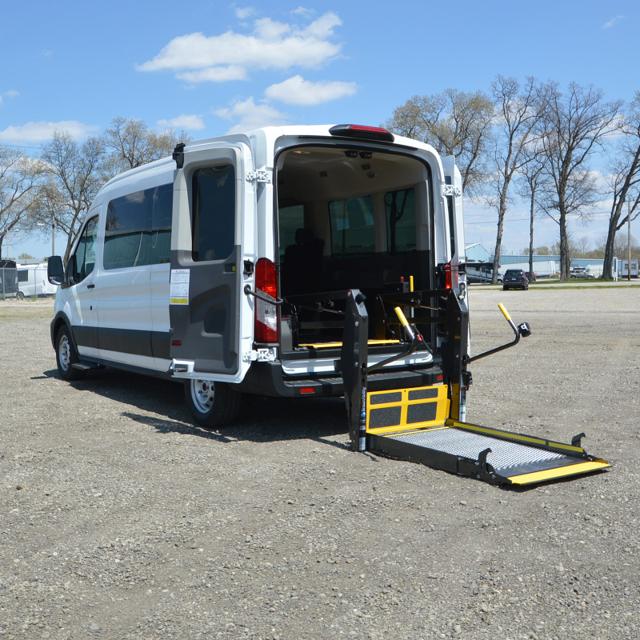
A raised-roof Ford Transit with a rear lift, two wheelchair stations plus 8–10 seats, a low step-in and a car-like drive. It fits a residential driveway, parks anywhere, and costs $85,000–$105,000 new. Many providers standardize on it across homes so any staff member can drive any vehicle and parts are shared.
Details that matter more here than anywhere else
- Securement systems. Four-point tie-downs with retractors, or docking systems if your riders' chairs are compatible. Drivers lose straps; we quote a spare set.
- Time on the lift. A curbside lift loads at the door, out of traffic, and lets staff stay beside the rider. Worth the extra body length on busy routes.
- Aisle width and seat pitch for riders who transfer from a chair to a seat, or who travel with a walker, oxygen or a companion.
- Interior surfaces you can clean, and a floor without lips.
- Behavior and safety options: driver partitions, rear-view camera, seat belts on every ambulatory seat, PA system.
- Standardization. Identical units across sites mean shared training, shared parts and no arguing about which van goes where.
Compliance, plainly
Lifts must meet FMVSS 403 and their installation FMVSS 404 — every lift we sell does, and the labels are on the vehicle. If your program is a public entity or operates service covered by the ADA's transportation regulations, the vehicle must also meet 49 CFR Part 38 (lift design load, platform size, securements); our guide explains when that applies. Waiver and licensing rules about vehicle inspection, driver training and documentation vary by state and program; we keep the conversion and lift paperwork on file so your compliance staff can pull it when a surveyor asks.
Paying for it
Most providers are 501(c)(3)s and claim the Pennsylvania sales-tax exemption on the title application with their exemption number; we prepare it. Tax-exempt lease-purchase spreads the cost across fiscal years when the capital budget is spoken for. If a vehicle is funded under FTA Section 5310, read our funding guide — Pennsylvania subrecipients generally buy those through the statewide contract, and we'll tell you so rather than waste your time.
Common questions
Our DSPs don't have CDLs. What can they drive?
Anything designed for 15 or fewer passengers including the driver and under 26,001 lb GVWR — which covers the Transit lift van and the 13+2 cutaway bus. Larger buses need a CDL holder.
Can one bus carry four wheelchairs?
Yes, on a 25-foot or longer body with four stations under flip seats. It reduces ambulatory seating, so most programs pair one four-station bus with standard 13+2 units.
Do you sell used vehicles to providers?
Yes, and we say what we found in the inspection — lift cycles if the controller records them, corrosion at the lift door and body mounts, securement hardware, labels. If we wouldn't put a family member on it, we don't list it.
Can you help us standardize a fleet across several homes?
Yes. We'll spec one unit, price a multi-unit order, and stagger deliveries to your budget years.
Get a written quote in one business day Configurations & prices
Tell us how many riders use chairs and how many sites you run.
We'll quote a standard unit for the fleet, with delivered pricing and a delivery schedule, within one business day.
Request a quote Call (717) 932-6060